You’re uploading regularly—so why does growth still feel random?
You post every week, the videos are solid, and the comments aren’t dead—yet the graph still looks like a dice roll. One upload pops, the next one flatlines, and you’re left guessing which tiny tweak “worked.” That’s usually not bad luck. It’s what happens when topic choice, the promise (title/thumbnail), and the first minute aren’t working together, so the system tests your video, gets mixed signals, and stops pushing it.
The trap is spending hours on low-impact polish—end screens, tags, fancy b-roll—while the big levers stay untouched. The fix isn’t a secret hack. It’s a simple audit: are you picking topics worth the time, making a clear promise fast, and holding attention long enough to earn wider testing?
Start there, and growth stops feeling random.
Before you script anything: are you choosing topics that deserve the next 6 hours?

Once growth stops feeling random, the next question is painfully practical: is this topic worth the next six hours of your life? Most creators don’t lose views because they can’t edit—they lose them because they pick “fine” ideas that don’t earn a click from someone who’s never heard of them.
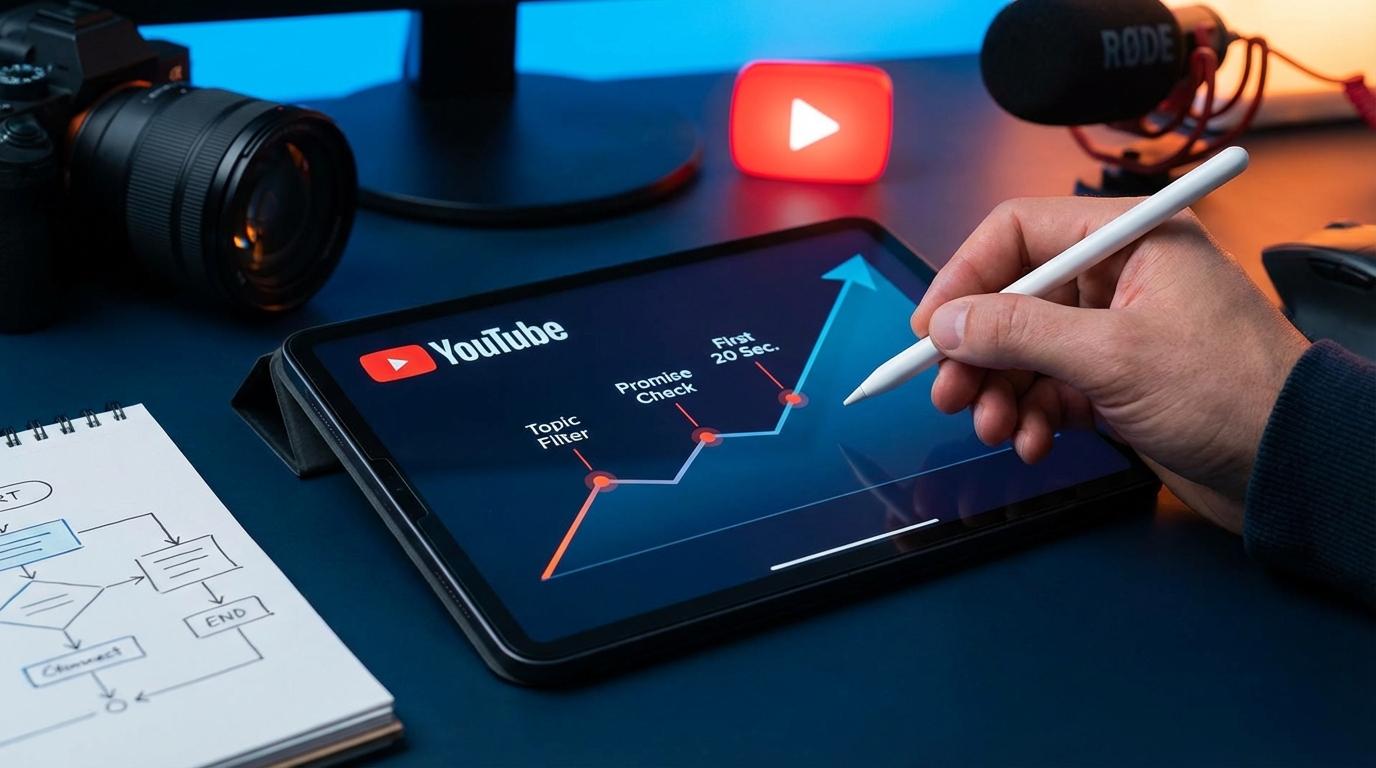
Before you outline, run a quick topic filter. If the viewer has one problem, can you say it in one sentence? If you can’t, the video usually turns into a grab bag. If the payoff is “my thoughts,” expect a soft response unless your audience already cares about you. And if the topic doesn’t create a clear before/after (save time, avoid a mistake, get a result), it’s hard to package.
Tighter topics can feel repetitive. That’s normal. Rotate angles, not categories—then your next thumbnail gets easier to write, not harder.
Your thumbnail isn’t ‘bad’—your promise might be hard to understand fast
When you rotate angles instead of categories, you usually end up with a stronger idea—but your click-through still stalls because the promise takes too long to decode. You’ll hear “make a better thumbnail,” so you swap fonts, sharpen the photo, and push contrast. The thumbnail still isn’t doing its job if a new viewer can’t tell what they get in under a second.
Run this simple check: show the title + thumbnail to someone for two seconds, then ask, “What do you think this video will help you do?” If they describe the topic (like “it’s about lighting”) instead of the outcome (“my video will look clean in a dark room”), your promise is fuzzy. Fix the promise, not the design: one clear result, one obvious constraint (budget, time, beginner), and one visual that supports it.
The friction is you’ll want to cram in every nuance. Don’t. Put nuance in the video—keep the promise sharp so the right people click, then you can earn the watch.
When viewers drop at 0:20, what do you change first?
Once the right people click, the next gut-punch is seeing a cliff at 0:20. Most creators respond by trimming pauses or adding faster cuts. Sometimes that helps, but a hard early drop usually means the opening didn’t cash the promise quickly enough, so viewers “check” and bounce.
Change one thing first: the first 20 seconds. Make it do three jobs in plain language—repeat the outcome (“By the end, you’ll know X”), prove you’re on the right track (show the finished result, a before/after, or the mistake you’ll fix), and name the path (“Here are the three steps”). If your title promises “Fix muddy audio,” don’t open with your channel story or a broad rant about microphones. Open with the muddy clip, the clean clip, and the exact fix you’ll demonstrate.
The trade-off is it can feel blunt or “too salesy.” Keep it short, then earn trust with the details—and you’ll give the rest of your structure a chance to work.
The week your schedule breaks: how Power Users keep shipping anyway
That blunt, fast opening works—until the week your schedule breaks and you miss your upload window. It’s usually not a motivation problem. It’s that your process assumes you’ll have a clean six-hour block, and real life rarely cooperates.
Power Users keep shipping by building a “minimum viable upload” path. They decide, ahead of time, what can’t move (topic + promise + first 20 seconds) and what can flex (b-roll, extra angles, perfect color). If you only have two hours, you still write the title/thumbnail promise first, then record an opening that proves the result, then teach the core steps. Everything else is optional. A simple screen recording with clear audio beats a half-finished cinematic edit that never publishes.
The trade-off is quality ego: you’ll feel like you’re lowering your bar. Counter it with a rule—your “emergency version” must still deliver the promised outcome, and you can polish later if it overperforms. Once you keep the streak alive, you can use analytics to decide what actually deserves that extra time.
Analytics without the spiral: which numbers tell you what to do next?

That’s where analytics helps—if you use it to choose work, not judge yourself. After a video publishes, most creators open Studio, see a few scary dips, and start changing everything at once. Don’t. Pick three numbers that map to the same three levers you’ve been pulling: topic + promise + first minute.
Start with impressions. If they’re low, the system isn’t testing you much, which usually points back to topic strength (not “better tags”). If impressions are healthy but views aren’t, check click-through rate on Browse/Suggested: your promise isn’t landing fast enough. If clicks are fine but the video stalls, look at audience retention at 0:30 and 1:00. A cliff at 0:20 means the opener didn’t cash the promise; a slow leak later usually means a step was too long or too vague.
The catch is timing. These numbers lag, so resist the urge to react to a single upload. Give each change a few uploads, then decide what to keep for the next 30 days.
Pick your next 30 days: three changes you’ll actually stick with
That “next 30 days” window is where most creators either get consistent or restart the cycle. Keep it simple: pick three changes and treat everything else as noise.
Change #1: a topic filter you run before you write. If you can’t state the viewer’s problem and the win in one sentence, park the idea. Change #2: a two-second promise test for every title/thumbnail. If a friend can’t tell the outcome fast, rewrite—don’t redesign. Change #3: a fixed 20-second opener template (outcome, proof, path), even on weeks you’re rushed.
The friction: you’ll want to “also” tweak ten things. Don’t. Lock these three for four uploads, then adjust based on impressions, CTR, and the 0:30/1:00 retention dips.